
1985

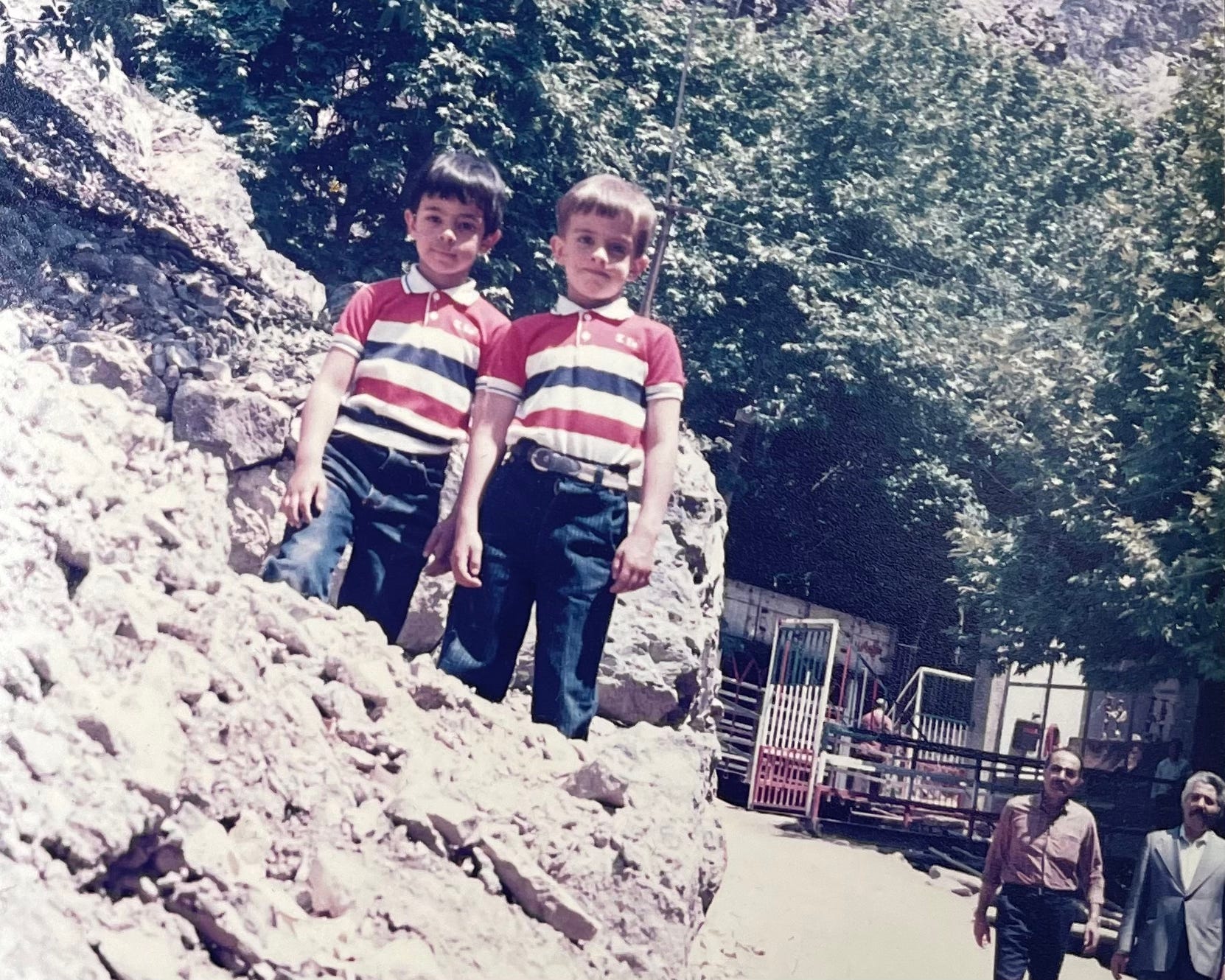
And now we’re in the air, my brother and I seated between our parents, marvelling as the pilot announces our descent into Tehran and the women around us all don headscarves. Mum looks funny in hers, but there’s something in her eyes that stops us from laughing.
Dad’s friend Mehdi is waiting at the airport. As my back meets the upholstery of his car I experience a heat that stuns me into silence. Through the window I watch the city unfold: hunched and broken looking shop fronts bearing mysterious script, men in drab jackets, women veiled. In the front the men talk and laugh, but I feel that same seriousness emanating from Dad when he turns to the window.
We pull up outside our grandmother’s house. Mum reminds me that I spent the first year of my life here. She and Dad moved to Tehran after they married, and we were going to live here, but then the revolution happened. I don’t remember the revolution, but I’ve seen the video that Dad watches over and over in our living room in Kent: seas of people, men sobbing, hands covered with what looks like blood, but which Dad tells me is paint.
Dad unloads the bags and I stand there savouring the smell of cakes from a nearby bakery. Water gurgles in the roadside canal, a breeze stirs up dust and scatters sunlight through trees that line the street. The gate creaks open and we step inside to where my grandmother is waiting, radiant as royalty. She stoops to kiss my brother and I more times than I can count, ushers us into a living room of pillars and chandeliers, velvet curtains, plastic flowers. Bijan and I chase each other around a bar in the corner, poke a dead cockroach, peer up at a framed picture of the grandfather who died not long after we left for the UK. We follow a corridor to where the back door opens onto a terrace, stairs leading down to a pool and a garden shaded by trees. Sounds of the city murmur behind walls reinforced with sheets of plastic, doubling their height.
The days that follow are a blur. We visit the bazaar, gripping our parents’ hands as we are led through vaulted passages, peering through gaps in the crowd to catch glimpses of old men bent double by boxes, spears of sunlight penetrating holes in the brickwork. We take a taxi to where the city gives way to the Alborz mountains and spend a day hiking, crossing rapids on terrifying log bridges. We stop in a tea shack straddling a waterfall, sip cokes on a carpeted day bed while dad struggles to smoke a shisha. Everywhere we go I am amazed by the looks we get from locals; here it is my English mother and fair-skinned brother who are the subject of stares and muttering from passers-by.
At the house we hang out with our cousins Dara and Haleh, who live downstairs. Dara is nine, two years older than me, and he has a computer that we crowd around to watch him do battle with the wireframe spiders of Firetop Mountain. Haleh is my age, cocky and Disney princess pretty. She sits with me in the shade of the terrace and helps me trace the Iranian alphabet in what feels like the wrong end of an exercise book. The four of us spend afternoons in the pool while the adults doze on loungers with drinks and sun-swollen paperbacks. Sometimes Auntie Jacqui invites Bijan and I down for dinner, and we eat chicken nuggets and chips, meals that make us sullen with homesickness.
Most evenings we attend dinner parties at the homes of my father’s friends. Each seems to feature the same leering faces and greasy lipstick kisses, the same men laughing at Dad’s stories and refilling his glass while Mum sits with the wives, her eyes suggesting she would rather be elsewhere. At one party, midway through a late dinner, conversation is cut short by sirens in the streets, and the lights go out. Voices rise in panic, and my brother and I cling to our mother. Candles appear, and the host ushers everyone through a door and down a flight of stairs. Some people carry chairs. We spend an hour in a basement, the adults playing cards by candlelight. At one point a man starts singing, others clacking out the rhythm with their fingers. When we ask what is happening, Mum tells us we are hiding from a storm.
We continue to play with our cousins, but Mum and Dad seem always to be looming, talking in low voices. I hear the word ‘Iraq’ a lot. In the evenings there are more sirens and blackouts, the sound of distant explosions. One afternoon we pack the car and Dad drives us to Karaj, two hours west of Tehran. We arrive at a house in the desert, and a lady welcomes us in. Over the course of the evening more people arrive, until there are maybe thirty of us. We eat a meal seated on the floor, then the men retire to another room. Bijan and I stay with the women, watching as Mum helps them lay out carpets and blankets on which we all bed down. The following morning Dad drives us back to Tehran, and we pass buildings that seem to have collapsed overnight. We are told the storms are getting worse.
After that we spend every night in Karaj. Some of the people start to feel like friends, though all seem subdued, and few speak English. One night I am lying awake on the floor when I notice flickering on the ceiling. I get up, pull my blanket around me and step carefully over women and children. I stand at the window and look through darkness to where lights flash silently on the horizon. After a while I turn to find my mother beside me. She tells me not to worry, that it’s just lightning over Tehran. Then she takes my hand and leads me through the room full of bodies, and we lie down together and close our eyes.
I believe the only thing we can do is transform that pain into something that hopefully leads to a different outcome. and to think of it as planting seeds that grow into trees in the shadow of which we would never get the chance to sit.
Oh wow.. I was reading this with (among other) Empress in the background.. your way of writing so vividly really projects a nuance of feelings and emotions. I was trying to imagine how old you were at that point and trying to remember how I was perceiving the world around me at that time. I felt the impulse of wanting to give that kid a hug and tell him that he has an amazing way of seeing the world unfolding and that every color he perceives will end up creating masterpieces. But it wouldn't make any sense to him, neither would I risk the butterfly effect of that act affecting anything of the present. So cheers to those colors, keep creating with them <3